Tag: Artificial Intelligence

  • AI in the workplace

    AI in the workplace

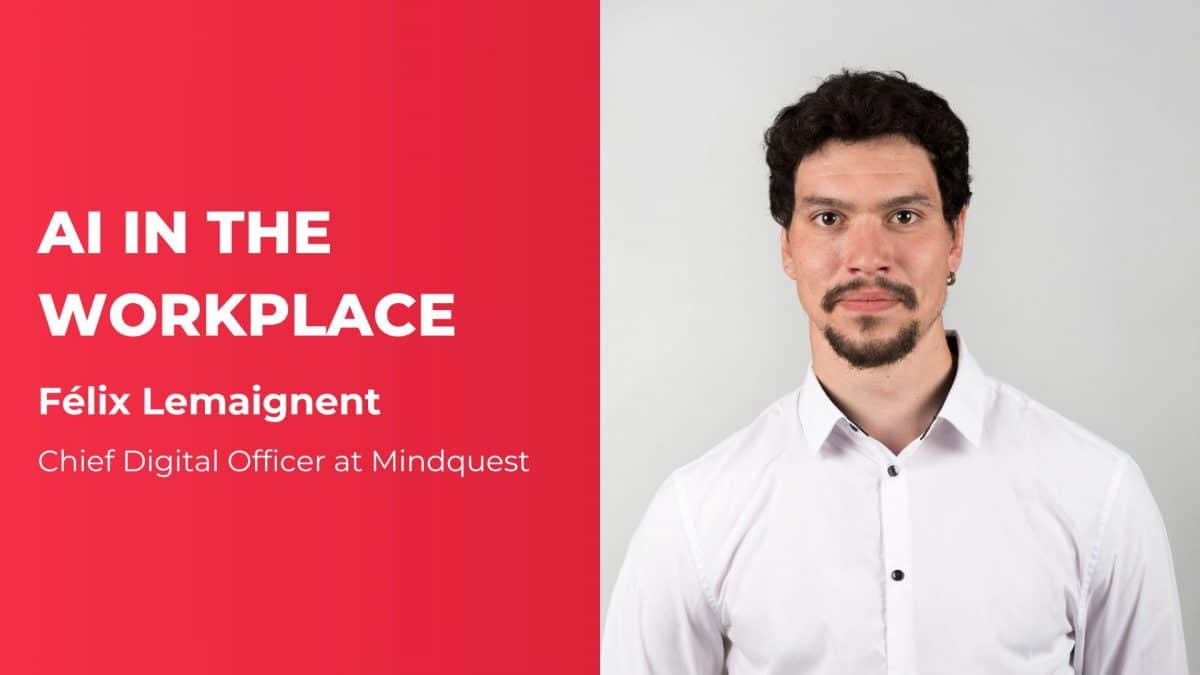
    In this post, we discuss AI in the workplace with our Chief Digital Officer, Felix Lemaignent.

    Need advice on how to start or develop your freelance consulting business in tech or IT? Need to start a new permanent or freelance assignment? Join Mindquest and get support from our team of experts.

    Who are the that AI revolution will affect employees affected and what are their challenges?

    Artificial Intelligence

    There are two categories of employees who will face different impacts. Firstly, those whose jobs will be directly transformed by AI. They will have to use it on a daily basis to accomplish their tasks, or work on its development. These are often technical or technology-related profiles. These employees absolutely must stay up to date on AI and understand how to integrate it into their work.

    Then there are employees in more traditional professions. They will experience an indirect impact. As with those who have already mastered Excel or Google, those who know how to use generative AI will have an advantage. They will be more productive and versatile, completing their tasks faster and more autonomously. However, this does not always guarantee a better quality of work.

    AI is already integrated into many tools, often invisibly. But here, we’re talking about generative AI, that works via prompts or a chatbot interface. This type of AI raises questions about the digital divide. Digital inequalities could increase with the rise of AI.

    In this AI expert job description you will find everything you need to know about this profile.

    AI in workplace: between challenge and opportunity for employees

    Artificial Intelligence

    Another main challenges is job-related fear. Many wonder whether AI will replace their jobs. Does using AI mean it can do the same job as them? In the case of budgets cuts, will they have to compete with their colleagues to keep their jobs? The ability to use AI to stay competitive will be essential in many areas. For some, AI represents a survival issue.
    For others, it is fascinating. Many people are already accustomed to learning new tools, but generative AI marks an important change.

    Unlike traditional tools with menus and buttons, AIs like ChatGPT work with text queries. This requires a new way of interacting with technology and developing critical thinking skills. It’s important to understand that the answers provided by AI are not always based on facts. They follow a probabilistic logic.

    As with the transition from fax machine to computer, generative AI marks a turning point. The computer has transformed employees into “equipped workers”. Those who master AI will become “augmented workers”.

    What are the risks for profiles that don’t train at the IAG?

    Artificial Intelligence

    The digital divide, already visible between generations, will widen between “augmented workers” and “outdated workers”. AI in workplace is here to stay. Those who train will become more competitive, more productive and more versatile. Employees need to be trained, whether in AI or in skills not covered by AI.

    But training alone will not suffice. Mastery of generative AI will come with experience and regular use. This process will develop the digital acuity that is essential to remain competitive.

    This reasoning also applies to companies. Companies that don’t invest in training their staff run the risk of being left behind. They will also have to deal with data protection and security issues. They can’t afford to have their employees blindly following the mistakes of an AI or copying unverified content.

    Will IAG become a criterion for employability?

    Artificial Intelligence

    Companies are looking to optimize productivity while reducing costs. A candidate capable of using AI is an asset. However, mentioning this skill on a CV is not enough. During an interview, the candidate must provide concrete evidence of the impact of these technologies on business problem-solving.

    Workers who have mastered AI show their curiosity, adaptability and versatility. These qualities make them capable of evolving and taking on new challenges – profiles that are highly sought-after.
    Generative AI is also becoming a valuable training tool. Coupled with lifelong learning, it makes it possible to rapidly deepen knowledge and put new concepts into practice. This capacity for self-training will be crucial to staying competitive.

    In career terms, the adoption of generative AI offers a competitive advantage. It accelerates skills development and broadens the scope of users’ tasks.
    Take the example of office tools: thanks to AI, a professional can use a wider range of Excel formulas without having to memorize them. Similarly, AI can suggest page layouts or structure PowerPoint content more effectively.

    In written communication, AI transforms the drafting of emails and reports. It speeds up the process and improves accuracy, clarity and tone. Employees gain in efficiency and credibility.
    These improvements go far beyond increased productivity. They enable employees to devote more time to high value-added tasks, such as strategic thinking or human interaction, which are essential for career development.

    Also, read Top 5 Strategies to Overcome the AI Talent Gap

    AI in workplace: what does Mindquest do for its employees and customers?

    Mindquest

    Mindquest offers AI awareness workshops to train its employees, as well as personalized coaching. We actively monitor prompting best practices, AI-related risks and the latest innovations.

    We also develop in-house AI tools to meet our needs while maintaining control over our data. Integrating AI into our recruitment processes is nothing new, but generative AI marks a major step forward.

    However, we remain vigilant about possible AI biases. At Mindquest, we have put safeguards in place to prevent these biases. AI is not a substitute for human expertise. Properly used, it improves efficiency and ensures fairness in our recruitment processes.

    Find your next assignment on our freelance and permanent IT recruitment platform, or join Mindquest so you don’t miss out on any job opportunity!

  • AI expert: Job description

    AI expert: Job description

    Use our template to create a compelling and comprehensive AI Expert job description to attract top talent.

    Certainly, artificial intelligence (AI) is already part of our daily lives (personal assistants, smartphones with facial recognition, etc.) and it is becoming increasingly important in the business world, with numerous technological applications (chatbots, maintenance of installations, etc.). In this AI expert job description you will find everything you need to know about the AI expert job, required skills, training, education, and salary expectations.

    Need advice on how to start or develop your freelance consulting business in tech or IT? Need to start a new permanent or freelance assignment? Join Mindquest and get support from our team of experts.

    AI expert: the job

    Technical skills

    What is the role of the artificial intelligence expert?

    The main task of the Artificial Intelligence (AI) Expert is to design computer programs capable of performing tasks similar to those performed by a human being. Both a researcher and a computer scientist, an AI expert can work in a wide range of fields.

    Also, discover Top 5 Strategies to Overcome the AI Talent Gap

    Keeping a constant watch

    The mission of the artificial intelligence expert is to solve complex problems. Research and analysis are therefore at the heart of the job. The AI expert must possess very advanced computer skills, as his or her expertise is constantly sought in the development of artificial intelligence projects. Since AI is still a relatively new field of expertise, the AI expert must constantly keep abreast of technological developments.

    Understanding and analyzing problems

    Since the role of the AI expert is to create software that mimics human reasoning, the expert must be able to analyze the human brain in relation to a problem and thus develop intuitive human-machine interfaces.

    Developing and designing solutions

    The AI expert can work on extremely diverse and varied projects. His or her day-to-day tasks are generally algorithm design, error checking, and programming.

    Required skills of the AI expert

    AI expert required skills

    Strong technical skills

    The job of Artificial Intelligence Expert requires advanced technical skills because AI-based applications cross many technologies (web crawling, data mining, data science, machine learning, deep learning, etc.).

    Strength of proposal, and ability to listen

    As far as soft skills are concerned, the AI Expert must show a strong spirit of initiative, interpersonal skills, and good listening skills. Since these qualities will enable him/her to carry out his/her projects successfully, communicate with all stakeholders, and call on external experts.

    Ability to work in a team

    To conclude, research in Artificial Intelligence is definitely not a solitary job. In fact, the AI Expert will have to work with various experts and will have to know how to federate these experts and listen to their advice to make progress in his research.

    Also discover the differences between Business Intelligence and Big Data

    Context

    AI expert context

    Expertise in Artificial Intelligence is very rare and therefore highly sought after. As a researcher and computer scientist, the AI Expert is highly qualified and can work in different fields of activity. Such as in ESN, in industrial companies, in research laboratories…

    In this post, we discuss AI in the workplace with our Chief Digital Officer, Felix Lemaignent.

    Salary

    AI expert salary

    The average daily rate of an Artificial Intelligence Expert is between 700 and 1500€.

    Training and education

    AI expert education

    To become an Artificial Intelligence Expert, you need to have a 5-year degree. You can enter this profession by having studied mathematics or computer science. However, you will need to continue your education and obtain a master’s degree or an engineering diploma. A specialized master’s degree or even a doctorate.

    Also read 5 Online Courses to Get You Up-To-Speed with AI

    After years of research and a lot of work, an AI expert can easily move on to new projects and join innovative start-ups in R&D, large companies, or research centers.

    You can also read : 20 AI Experts You Should Follow

    Find an Artificial Intelligence Expert job with Mindquest

  • 10 Top AI Experts in the UK to Follow Online

    10 Top AI Experts in the UK to Follow Online

    With artificial intelligence evolving so rapidly, it can be hard to keep up with new developments, best practices and the industry’s overall state of the art. For this reason, we at Mindquest suggest you this list of top AI experts in the UK that will help you stay in the know and future-proof your career in AI.

    You can also read 5 Online Courses to Get You Up-To-Speed with AI and AI expert: Job Description

    Need to start a new permanent or freelance assignment? Join Mindquest and get access to our job offers.

    Top AI experts in the UK to follow

    As the IT environment is constantly evolving, it is crucial, if not necessary, to connect with the brightest minds to keep up with innovation. In other words, the more contacts you get, the more likely you are to solve IT challenges. Therefore, we at Mindquest to provide you with a list of the AI experts in the uk to follow.

    Disover A Career in Data Science: Unlocking The Power of Data with AI

    Tabitha Goldstaub

    Twitter | LinkedIn

    To start, Tabitha, board member of Luminate, is the co-founder of CogX, the chair of the UK Government’s AI Council and an advisor for The Alan Turing Institute. She is also the author of How To Talk To Robots: A Girl’s Guide to a Future Dominated by AI.

    Rob McCargow

    Twitter | LinkedIn

    To continue, Rob is the director of AI at PwC UK and a champion for the responsible use of technology and AI. He is also an advisor for the IEEE and the UK’s All-Party Parliamentary Group on AI and a TEDx speaker.

    Sarah Porter

    Twitter | Linkedin

    Then, Sarah is the founder and CEO of InspiredMinds, a global community and strategy group focusing on the use and development of AI for good in line with the UN’s sustainable development goals.

    Yarin Gal

    Twitter | LinkedIn

    Let’s go on with Yarin, an Associate Professor of Machine Learning at the University of Oxford’s Applied and Theoretical Machine Learning Group, helping produce groundbreaking work like this set of Bayesian Deep Learning benchmarks.

    Elena Sinel

    Twitter | LinkedIn

    Elena, on the other hand, is the founder and CEO of Teens in Ai, a global initiative launched at the UN’s 2018 AI for Good Global Summit and that seeks to inspire the next generations of ethical AI researchers and practitioners.

    Connect by Mindquest Newsletter

    Danilo Rezende

    Twitter | LinkedIn

    Danilo, then, is a Senior Staff Researcher and lead of the Generative Models and Inference group at DeepMind, London. His research focuses on scalable inference and generative models for decision-making and hard science problems.

    In this post, we discuss AI in the workplace with our Chief Digital Officer, Felix Lemaignent.

    Allison Gardner

    Twitter | LinkedIn

    Next, recently MP for Stoke-on-Trent South at UK Parliament, a lecturer and data science apprenticeships program director at Keele University, Dr Allison Gardner is co-founder of Women Leading in AI, which brings together AI and business leaders to discuss the future of AI. 

    Edward Grefenstette

    Twitter | LinkedIn

    Further, Edward is Director of Research for Google DeepMind, he has been a Scientist and RL Area Lead at Facebook AI (FAIR) and an Honorary Professor at the Deciding, Acting, and Reasoning with Knowledge (DARK) Lab at the UCL Centre for AI.

    Wendy Hall

    Twitter

    Then there is Wendy Hall, a Dame Commander of the British Empire (DBE) and a champion for UK AI skills and women in science. She is Chair of the Ada Lovelace Institute and joined the BT Technology Advisory board earlier this year.

    Ankur Handa

    Twitter | LinkedIn

    Last but but not least, Ankur is a Robotics Research Scientist at NVIDIA AI and a Research Scientist at OpenAI working at the intersection of computer vision and control for robotics. He did a post-doc at Cambridge University and has a PhD from Imperial College London.

    Do you have any other AI experts in the UK who should be featured in this or future lists? Shoot us an email.

    Also discover our articles 10 of the Best Software Developers in the UK to Follow Online

  • Weekly News: Online Traders Hit Wall Street

    Weekly News: Online Traders Hit Wall Street

    Here’s what happened this week in IT news.

    ? Subscribe to the podcast

    Join our community and find your next job or expert in IT

    Amateur traders take on Wall Street’s old guard

    The Internet can be a fascinating place. And
    especially Reddit. Mix online stock trading with a pinch of cancel culture and
    a good amount of memes and, boom: a bunch of Wall Street big shots lose
    millions in a matter of hours. 

    Retail investors using low-cost, online trading platforms like Robinhood organised through the ‘WallStreetBets’ subreddit to do something they had been wanting to do for a while now: get back at hedge funds and other traditional investors who make money by betting on failing companies (aka shorting).

    These
    amateur traders, who see themselves as part of a new wave of anti-establishment
    investors, went on to inflate the stock price of GameStop, a now-failing
    American brick-and-mortar videogame store. Wall Street had borrowed many of the
    company’s stocks, sure these would go down in price and they’d be able to make
    a profit upon returning them. 

    Ouch. Certainly a clear reminder of the power that the virtual world can have over the real one.  

    BBC

    Davos goes virtual

    Like pretty much any other large event whose
    organisers sport a bit of common sense, this year’s gathering of the World
    Economic Forum is being held fully online. Its focus this time around?
    Surprise, surprise. You guessed it — pandemic recovery. 

    Specifically,
    the organisation consulted world business leaders ahead of the start of the
    talks conference talks about how technology should be used to help reset our
    society, economy and business environment.

    Cloud and
    collaboration tools to strengthen community ties and help us predict and
    address health crises. Accelerated digital transformation to keep improving
    business models and ultimately people’s lives. Widespread use of AI to automate
    repetitive tasks and allow businesses to focus on adding real, high-end
    value. 

    The underlying theme: prioritising the common good. 

    World Economic Forum

    A five-year timeline for AI in the enterprise

    A newly published Gartner report aims to do
    something at which most tech predictions tend to fail: getting too specific
    with the time estimates.

    The study
    looked at the unintended ethical and social repercussions of AI adoption and
    then provided recommendations on what business should do to address them. 

    By 2025, our world could look quite scarier than it does today in terms of privacy and cybersecurity. Large-scale AI models will be concentrated in the hands of 1% of vendors. Deepfakes will be so common companies will have to conduct regular employee trainings on how to spot them. About 75% of workplace conversations will be analysed to add organisational value and assess risk.

    Learn more about AI: 5 Online Courses to Get You Up-To-Speed with AI

    The most obvious routes for businesses to take include setting up ethic boards at companies that sell or use AI and establishing guidelines for responsible AI consumption.  

    TechRepublic

    Check out more of our interviews from our podcast episodes.

  • Weekly News: The Funny Side of AI

    Weekly News: The Funny Side of AI

    We are often discussing the dangerous implications of AI and what we can do to address them: bias, job losses… So it’s refreshing to be able to talk about its more benign side effects. Discover the funny side of AI.

    3 stories to discover the funny side of AI

    Football or bald head?

    Do you enjoy football? How about bald heads?

    Since the start of the pandemic, the world of sports has had to
    forgo live audiences in favour of live streamings. Bigger teams and leagues can
    afford proper TV crews to cover their matches, but smaller teams need to be
    more creative.   

    A football team in Inverness, Scotland decided to use an AI-enabled camera to track the football’s movements. Unfortunately, and to the delight of the whole world, the camera tracked the referee’s bald head instead of the ball. Best match ever.

    TNW

    IT Job Hunting Done Well: A Step-by-Step Guide

    What drones are really for

    Few technologies
    have received as much public hype as drone technology. We all have a friend who
    enjoys chasing flocks of sheep with their little quadcopter. If you don’t, then
    you might be that friend.

    But what are drones actually good for?

    The non-consumer applications that first come to mind tend to be
    rather pessimistic. Surveillance, warfare… There is an understandable trust
    deficit when it comes to drones, but the technology’s potential is huge if we
    manage to overcome it.

    From humanitarian aid in dangers zones to remote delivery and agriculture, drones can be extremely helpful in helping us get where we need to get more easily and in time. 

    TechRadar

    Funny side of AI: Game over for 1809

    Microsoft is
    discontinuing service for Windows 10 version 1809 starting on November 10, so
    make sure all your systems are upgraded accordingly.

    The cut will affect Windows 10 1809 for Home, Pro, Pro for Workstations, and IoT Core, which will stop receiving security updates and support.

    Support for Windows 10 1803 for Enterprise, Education and IoT Enterprise will be extended until May 2021, as will the Enterprise and Education versions of 1809.    

    TechRepublic

    Discover more articles about AI

    Read our article: AI, IBM Chips, and a Novel Cloud Security Concept: The Week in Tech News

    ? Subscribe to our podcast

  • Weekly News: The Rise of The Machines

    Weekly News: The Rise of The Machines

    Weekly news. Discover our news about IT: the rise of the machines, Bitcoin goes mainstream and Robin Hood strikes back

    The rise of the machines

    New report by the World Economic Forum (WEF) has forecasted that as much as half of all work tasks could be handled by machines by the year 2025. The rise of machines.

    The think tank’s research, which spanned 300 of the world’s
    biggest companies, estimates that the so-called “robot revolution” will
    create 97 million jobs around the globe but destroy almost as many. 43% of
    respondents felt they were likely to cut jobs due to technological
    transformation in the near future.

    Yet new jobs will emerge as a result, especially in the areas of healthcare, big data and the green economy. However, the Forum is calling for a conscious effort to ensure that no sectors of society are left behind.

    BBC

    Bitcoin goes mainstream

    PayPal has announced
    that it will start allowing transactions in Bitcoin. The firm will also provide
    support for other cryptocurrencies including Ethereum and Litecoin.

    The new features, which will debut in the U.S. shortly and
    worldwide next year, mark an important milestone in the normalisation of
    cryptocurrencies. 

    The company sees the economy’s shift to digital currencies as inevitable, and it is committed to helping make them easier to use by the broader public. 

    TechRadar

    Robin Hood strikes back

    A new emerging trend has cybersecurity and legal experts baffled: charitable cybercrime.

    Also read our article & discover our interview: Leadership Failure: The Real Human Element Behind Cyber Attacks

    The ransomware-as-a-business group DarkSide introduced itself to
    the world earlier this year, issuing a press release where they detailed how
    they picked their victims and pledged to leave non-profits, healthcare and
    governments alone. 

    Well – these cybercriminals with a strong moral code are now
    taking it to a whole new level: they are donating their profits to charities.   

    Two US-based organisations received equal payments of 0.88 bitcoin (or $10,000) in mid-October, money they say they will return as soon as possible. The authorities are warning NGOs around the globe to not accept donations from these cyber schemes, as that would make them legally liable for profiting from crime.  

    ComputerWeekly

    Connect with Mindquest Newsletter

    ? Subscribe to the podcast

    20 Amazing Women Leading Europe’s Tech Revolution

  • Weekly News: Artificial Intelligence, Minecrafting the Real World

    Weekly News: Artificial Intelligence, Minecrafting the Real World

    Since 2018, the Generative Design in Minecraft (GDMC) competition challenges participants to push the limits of artificial intelligence and come up with realistic cities from scratch.

    If you are unfamiliar with Minecraft (I doubt it), the cube-based video game lets players build all sorts of structures with almost absolute freedom. In other words, cubic freedom.

    Participants must leverage a combination of various Artificial Intelligence techniques in Minecraft to level terrain, build roads and bridges and erect buildings. It is a very complex task involving everything from path-finding algorithms to machine learning, but it’s starting to come together. 

    Surely the technology is still years away, but it looks like city planners and designers will soon have a new digital partner for their construction projects.

    Your future apartment
    building might well be designed by an AI architect. At least parts of it.

    Racist Artificial Intelligence strikes again

    And speaking of artificial intelligence I, yet another poorly trained algorithm has put yet another Internet giant in serious trouble. This time it was Twitter’s turn. 

    Have you ever wondered how the platform decides what parts of a
    picture to crop in preview mode? It is, of course, an image-cropping algorithm.
    Using a combination of tools, Twitter tries to prioritise faces and text,
    unless your face is black. 

    Ironically, the issue was discovered when a PhD student was
    trying to tweet about another racially-biased algorithm he had encountered on
    Zoom. The videoconferencing service had erased the image of his black colleague
    after failing to recognise his face. Twitter decided that wasn’t enough and
    erased his colleague from the screen capture too. 

    Although the company was quick to apologise for not testing the algorithm thoroughly enough, Twitter feeds quickly filled up with people doing experiments to test the flaw. Some even tried posting images of differently coloured dogs. 

    Time for lessons to be learnt.

    Announcements from Microsoft Ignite

    Microsoft has
    kickstarted its annual Ignite user-focused conference by announcing a series of
    additions to its cloud and productivity portfolios. 

    Teams is getting new security and compliance-related features,
    as well as a suite of new tools to help companies better support remote
    workers. The latter are mainly data insights to assess the overall wellbeing of
    employees, made available to users and managers to help them improve
    productivity and reduce burnout.

    The company has also teased Virtual Commute, an upcoming Teams functionality aimed at helping workers unwind after a long day of work. Hmm, how about not being on Teams after working hours to start with?

    Plans to expand Azure Stack’s hybrid cloud capabilities have also been announced. The platform lets businesses run public cloud-like workloads within on-premise data centres. Users will be now able to run and deploy containerized applications on the setup, while the Azure Stack Hub will incorporate GPU support for broader machine learning capabilities. 

  • 5 Online Courses to Get You Up-To-Speed with AI in 2023

    5 Online Courses to Get You Up-To-Speed with AI in 2023

    Spoiler alert: Artificial Intelligence is the future of work. Or at least part of it. This is not to say that everyone will become an AI engineer. But in just a few years from now, a large part of job positions will require or reward AI skills that help employees be more efficient and dedicate themselves to higher-level tasks. Especially in areas like IT, where human error can have dire consequences. So what online AI courses are best to get you up-to-speed with this booming discipline?

    AI has experienced a major explosion in popularity in recent years, becoming one of the fastest-growing roles in job markets across the world. Indeed, just at the beginning of the 2020, a LinkedIn report identified AI-related skills as the fourth most in-demand skills group among employers. And that was before the pandemic set in.

    Since then, Artificial Intelligence has emerged as a compelling choice for students and professionals who want to keep up with innovation and trends. Analytics Insight points out very good reasons to study AI in 2023.

    Bottom line: believe the hype. It’s about time you put on your AI boots if you still haven’t done so. Here are five courses to get you started that touch upon some of today’s core AI skills.

    Find your next assignment on our freelance and permanent IT recruitment platform, or join Mindquest so you don’t miss out on any job opportunity!

    1. Online AI courses : the basics

    Artificial Intelligence

    Firstly, how comfortable would you feel explaining to someone the difference between AI, machine learning and deep learning? What comes to mind when you hear the words ‘neural network’?

    If you are not quite sure, start with the fundamentals. This Coursera course by IBM provides a good introductory overview of artificial intelligence and its many aspects:

    2. One of the most popular online AI courses : Python

    Python

    Python is to AI what English is to Shakespeare’s plays. Thus, this nimble yet powerful language is one of the most popular among programmers and engineers, and, if you haven’t gotten around it already, well – you should.

    This course on Udemy kicks
    off with a Python crash course and then gets into its data science and machine
    learning applications, covering the most widely used Python libraries and tools
    for AI (NumPy, Pandas, Matplotlib…):

    Need tips on how to find a job in IT? Check out our IT job hunting guide.

    3. Machine learning

    Machine Learning

    In essence, machine
    learning is the use of algorithms to process data, learn from it and then act
    according to these learnings. Machine learning allows computers to autonomously
    learn and improve processes and assessments through experience, without being
    explicitly programmed beforehand. It’s pretty much ubiquitous these days –from
    your phone’s predictive keyboard to web searches.

    This course by
    Stanford is a good starting point:

    4. TensorFlow, neural networks and deep learning

    TensorFlow

    Moreover, developed by Google Brain Team, TensorFlow is an open-source library for numerical computation with powerful AI capabilities. TensorFlow is Python-friendly and is currently one of the most in-demand AI skills.   

    This video offers a
    great hands-on introduction to building neural networks with TensorFlow:

    The course requires
    previous Python literacy, so you should not jump into it before learning the
    language.   

    5. Natural Language Processing (NPL)

    Natural Language Processing (NPL)

    Last but not least, NPL is a branch of artificial intelligence that focuses on analyzing, understanding and producing human language. It is an integral technology to many everyday features of the digital economy, from autocorrects to chatbots.

    This Codecademy course
    provides a practical and project-based introduction to NPL:

    Are you looking for IT mission opportunities in the Tech and IT sectors on a freelance or permanent basis? Mindquest can help you find your next IT mission opportunity. Find your next mission by browsing our freelance and permanent vacancies available on our digital recruitment platform.

  • Weekly News: How brain-like should AI be?

    Weekly News: How brain-like should AI be?

    How brain-like should AI be? Cloud and clear, Microsoft… News from the frontlines… Discover our Tech & IT weekly news.

    How brain-like should AI be?

    What constitutes intelligence and how do we
    replicate it? Computer experts and neuroscientists have long been after a
    universal theory of intelligence. The idea is simple — the more we understand
    how the brain works, the better our AI will be.

    Well, not exactly. 

    Kelly Clancy, a neuroscientist working with
    Google’s DeepMind, delves deep into the issue in this WIRED article. Her
    main point? Two different roads often lead to the same place. 

    AI developers should keep in mind that what works for our brain might not work in machines, and vice versa.

    Not enough AI in your life? Here’s a list of books on artificial intelligence that you can read.

    Learn more about Microsoft with our Microsoft Technologies Careers Guide

    Cloud and clear, Microsoft

    Speaking of AI – during its annual Built
    conference, Microsoft unveiled a new partnership
    with OpenAI
    to develop an Azure-hosted AI supercomputer.

    The computer will be among the 5 most
    advanced supercomputers in the world. It will be deployed to test large-scale
    models and advance towards general artificial intelligence.

    Microsoft also announced its first industry-specific cloud offering for the healthcare sector. The solution, which is now available in public preview, connects products like Microsoft 365 for marketing and customer service and Azure IoT. 

    Use cases include the development of a “patient journey” that helps manage patient care and maximises positive outcomes.

    News from the frontlines…

    One more week means one less week until
    things start looking normal again. This is what the tech world is doing to help
    in the fight against COVID-19…

    If the pandemic has taught us anything about
    retail IT is that, unlike larger companies, SMEs don’t always have the means to
    shift to digital operations when needed. In what is big news for e-commerce,
    Facebook has launched Shops, a new
    service that will allow companies to sell products on its platforms.

    The debate over the effectiveness of contact tracing technology rages on. Industry competitors and researchers are teaming up against all odds to create apps that respect user privacy, but poor adoption could undermine all these efforts. Nature magazine takes an in-depth look at the issue

    Plenty going on with tech these days. Even Microsoft’s CEO, Satya Nadella, used his keynote speech at this year’s Build to congratulate the tech industry’s response to the global crisis.

    ? Subscribe to our podcast

    Join our community and find your next job or expert in IT

    Also discover our Weekly News: How Tech Is Rewiring our Brains

  • AI for recruitment: How AI will allow recruiters to focus on people

    AI for recruitment: How AI will allow recruiters to focus on people

    AI for recruitment. AI penetrates all areas and promises tremendous gains in efficiency, speed and performance. There has been a lot of media buzz lately around its recruitment applications. What long-term impact will AI have on the staffing industry? Used well, these new technological tools will allow recruiters to focus on their added value and; paradoxically; make the recruitment of the future more human.

    AI promises in automation

    For the past twenty
    years, we have witnessed an ever more extensive and efficient automation of the
    recruitment processes. These developments are built upon extremely complex
    analytical models. Defining and anticipating the skills that the company needs,
    identifying the most suitable talent and ranking candidates based on precise
    job criteria are processes that require taking into account many variables.

    Moreover, through its ability to consider contextual elements as rich as they are varied, artificial intelligence promises to make this level of automation a reality. In a field like IT recruitment, where time is of the essence, being able to quickly match candidate profile with company requirements is a decisive advantage.

    Artificial intelligence in IT recruitment

    In the recruitment of IT freelancers, for example, AI makes it possible to process very quickly huge volumes of data linked to the profiles of candidates. Previous gigs, areas of expertise and preferred sectors, years of experience… But also exogenous data such as the candidate’s place of residence and travel times. AI also makes it possible to analyze the quality and interest of the positions offered. Helping identify the types of projects that are most promising in terms of career development.

    Furthermore, considering elements linked to quality of life or to the characteristics of the offer maximises the chances of success of an investment; by making it possible to identify profiles with high potential and that are likely to be interested in the mission.

    AI for IT recruitment: Towards an uberisation of recruitment?

    AI’s capabilities are making great strides in matching supply and demand. Hence the emergence of fully automated solutions, of players who “platformise” recruitment. Which bring about a vision of recruitment as an almost exact science.

    This vision would like technology to replace human appreciation entirely; thus putting an end to the recruitment profession and replacing it with ever more sophisticated and intelligent algorithms.

    But this vision is implausible. Recruiting is not just a science, it is also an art.

    IT recruitment: the human touch

    In recruitment more than in any other field, the human being occupies by definition a central role. Soft skills, matching the values ​​and culture of the company, and compatibility with other team members… They are all key factors for a successful placement. As much as the level of education, years of experience, references or results obtained in a technical test. And yet, these are all parameters that an artificial intelligence can never assess as well as a human.

    Even more so when we talk about recruiting for high-level positions. It is hard to imagine choosing a CIO or an Innovation Director via a fully automated process. Neither the candidate nor the company would subscribe to it.

    Discover 5 Online Courses to Get You Up-To-Speed with AI

    From artificial
    intelligence to augmented intelligence

    It is really a
    question of going beyond the dialectic “all digital vs. all human”.
    Recruitment professions must integrate AI and make the most of it as a tool for
    human decision-making. And thus allow the business to refocus on its true added
    value.

    AI involves a real qualitative leap, reducing the risk of error and saving unprecedented amounts of time. AI will certainly replace humans on certain tasks, but mainly in repetitive and boring tasks. It increases the performance of the recruiter by allowing faster and more targeted searches. And thus optimizes time and communication with the candidate. Far from dehumanizing the relationship, AI, on the contrary, allows us to focus even more on humans.

    Artificial intelligence for recruiter: the next level

    This is good news for recruiters. These new tools will allow the profession to gain new levels of recognition, with richer and more interesting daily tasks. Also, it will give us the ability to understand the needs of the company in terms of skills. To create a stronger connection with the candidates. As well as to understand the aspirations and constraints of each party involved.

    It is also and above all good news for candidates. Because recruiters will be able to devote more time to them and offer them a better experience. Firms will be able to enrich their service offer with more support. Especially in the key stages of onboarding and taking of office of the selected candidate.

    It is, therefore, the human-machine association, the combination of artificial intelligence and emotional intelligence. That will revolutionise recruitment and put people back at the heart of the processes. We may no longer be talking about Artificial Intelligence, but augmented Intelligence.

    Join our community and find your next job or expert in IT

    Sign up to to Mission Contol Center Newsletter

    ? Subscribe to the podcast

    IT Pros: 3 Areas of Focus to Get 2021 Right