Tag: tips and tricks

  • How to implement an efficient ERP in 6 steps

    How to implement an efficient ERP in 6 steps

    Certainly, to implement an efficient ERP is a crucial task; choosing a cloud-based solution can make the process faster. However, since an ERP covers the entire range of business functions, it is important to perform all the necessary steps carefully and methodically.

    Switching to a new system, or activating it from scratch, requires a major preliminary analysis, a careful migration and testing process, scrupulous staff training, and fine-tuning of the system.

    For this reason, we at Mindquest have summarized the various phases of this process in the following 6 steps.
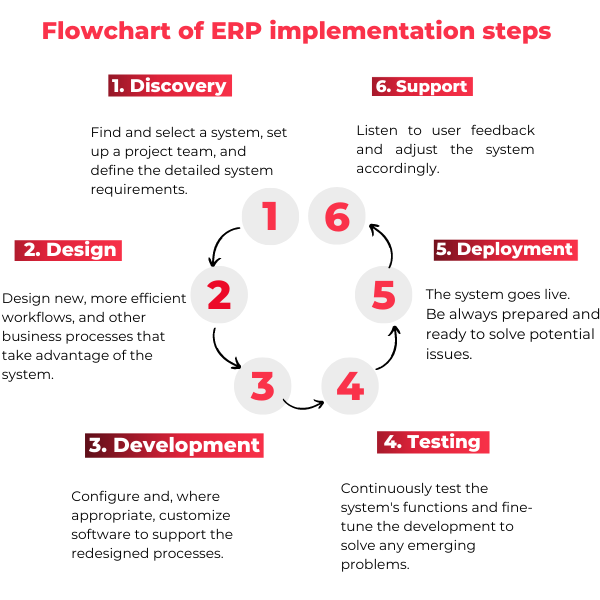
      Flowchart of ERP implementation steps

    Flowchart of ERP implementation steps

    Also read the advantages and disadvantages of SAP

    1. Discovery and planning

    Firstly, discovery and planning is perhaps the most important phase: if done methodically, it helps reduce time, cost, and risk. This phase consists of researching and selecting a system, establishing a project team, and defining detailed system requirements.

    2. Design

    Then, by analyzing the hardware and software infrastructure in place, new and more efficient workflows and other business processes can be designed to take advantage of the system.

    In particular, if the choice falls to a cloud-based ERP, it is critical to check the quality, stability, and security of Internet access. Systematic analysis of information flows is critical here. Single systems may, in fact, perform less well than industry-specific products.

    At this stage, it is also critical to define a team responsible for the process. Since the implementation is a complex task, dedicating resources makes it easier to interface with the support team.

    3. Development

    In addition of having performed the audit and mapped the information flows, assigned functions and responsibilities, and identified the most suitable solution, the actual implementation phase begins.

    This step consists of the configuration of access and permissions. The ERP is used by several users and in different capacities. It is therefore important to set permissions and roles for access according to one’s user profile.

    It also includes the preparation of the data and processes to be migrated. Preliminary analysis helps to resolve any format incompatibilities in time. Centralized data management eliminates redundancies and duplicates

    4. Testing

    During this phase, it is valuable to continuously test the functions of the system and refine the development to solve any emerging problems.

    Fine-tuning, it is to say, testing the system to gradually verify the results of the migration process and adjust any discrepancies in use and access.

    5. Deployment

    Once this phase is also completed, we move on to the actual operational verification of the new ERP. This is accompanied by staff usability testing.

    With the new ERP fully operational, it is possible to observe its actual operation. Preliminary analysis and partial testing are useful, but the go-live is the real litmus test.

    6. Support

    In the initial break-in period, the work of the support and service team is critical. This is also the reason for choosing not only the ERP, but also the company that provides it.

    Maintaining the ERP implementation after deployment helps keep users satisfied and ensures that the company achieves the desired benefits.

    Last but not leas, the project team may remain responsible for the ERP system during this phase, but will focus on listening to user feedback and adjusting the system accordingly.

    Further development and configuration may be needed as new features are added to the system. It is also critical to train new staff on the system to implement an efficient ERP.

    Are you looking for freelance or permanent assignments in the ERP field? You can now apply for our Tech & IT job opportunities on our freelance and permanent recruitment platform.

    You can also explore the role of the SAP FICO Consultant

    Need advice on how to start or develop your freelance consulting business in tech or IT? Need to start a new permanent or freelance assignment? Join Mindquest and get support from our team of experts.

  • 8 mistakes to avoid in Business Intelligence (BI)

    8 mistakes to avoid in Business Intelligence (BI)

    IDC estimates that the business intelligence market will continue to grow at a rate of 8 percent through 2022. But despite the success of these types of business software solutions, most projects fail at some point in their implementation. What are the causes? How can they be avoided? To help you, we at Mindquest collected a list of 8 mistakes to avoid when it comes to Business Intelligence.

    Need advice on how to start or develop your freelance consulting business in tech or IT? Need to start a new permanent or freelance assignment? Join Mindquest and get support from our team of experts.

    Business Intelligence: decision-making technology

    The purpose of Business Intelligence (BI) solutions is to provide information that facilitates decision-making with real-time data. Therefore, in an ever-changing environment, BI software is increasingly indispensable.

    Moreover, the union between BI and Data Science is expanding the horizon of possibilities of Business Intelligence to limits that were unimaginable just a few years ago.

    But in order for your company to benefit from all this business decision-making technology, it is necessary to carry out a good implementation.

    The following are the 8 most common mistakes to avoid when it comes to Business Intelligence.

    Also read our Business Intelligence Analyst job description

    The 8 mistakes to avoid in Business Intelligence

    mistakes to avoid Business Intelligence

    Business Intelligence mistakes that companies often make are often the same. Therefore, let’s take a look at the “manual of bad practices” in Business Intelligence implementation.

    Firstly, avoiding a BI software implementation problem means anticipating it, which is why it is necessary to know in advance.

    1. Not defining the objectives of the software properly in the planning phase

    To start, it is a big mistake to think that just by setting up a BI solution it will work by itself, as if by magic. Business Intelligence is just a tool, and it will work as long as it is handled with skill.

    For it to work, the objectives to be achieved with the implementation need to be set from the outset. These must also be aligned with the business objectives. This is the only way to get a return on the investment in Business Intelligence.

    2. Give all the power over the BI tool to the IT department

    Related to the previous point, for the software to be
    aligned with business objectives, the implementation must transcend the IT
    department.

    In other words, the more business-oriented managers and executives must actively participate in defining the objectives that the BI must meet.

    3. Choosing a Business Intelligence technology that does not meet the requirements of the business

    There is a multitude of software vendors with different technical and functional solutions on the market, and then there are customized solutions. Whatever your company may select, the software must be tailored to your business needs.

    Be suspicious of one-size-fits-all solutions. Since the best business intelligence technology will depend, in most cases, on the size of your company, the sector in which you operate, the type of activity, etc.

    4. Not doing a good job of integration

    For the BI solution to deliver the desired results, integration with the company’s databases is crucial.

    Companies that still rely on Excel for everything have a problem in this regard, and need a complete overhaul of their systems. BI that is well integrated with data from ERP, CRM, etc., is crucial.

    5. Neglecting data quality

    One of the consequences of not doing a good job of
    integrating with the company’s databases is poor data. But there are other
    reasons why data may be of poor quality, irrelevant or incomplete.

    There must be controls in place to avoid loading erroneous data into Business Intelligence, ETL (Extract, Transform, Loud) processes, etc.

    6. Prioritize the front-end and leave the back-end in the background

    Although the purpose of a BI tool should be to present dashboards, reports, and charts visually that facilitate the analysis of information (front-end), the configuration of internal processes (back-end), which are responsible for processing all the information that is then to be displayed, should not be overlooked.

    Giving equal importance to the back-end and front-end is crucial for choosing the right technology when implementing or developing a Business Intelligence solution.

    7. Not sufficiently protecting your BI data

    Certainly, developing a solution with self-service options that democratize data and extend it to more internal users is often beneficial to a company.

    Mobility also enables more practical use of technology,
    allowing, for example, access to reports from a smartphone or other device from
    anywhere.

    But all this can also pose a serious security problem when an employee views information to which he or she should not have access or an employee loses his or her smartphone, opening the company’s doors to any stranger. Effective controls need to be put in place to ensure legal compliance and company security.

    8. Forgetting the end user

    Last but not least, training the employees and professional profiles that must handle the Business Intelligence solution is fundamental if we want them to use it.

    Low adoption is one of the main reasons why the
    implementation of BI in the company can fail.

    A good training program is very useful, but it is not enough. The employee must understand why it makes sense for the company to use Business Intelligence, and why it is important for them to use it.

    Also read the differences between Big Data and Business Intelligence

    Conclusion

    To conclude, Business Intelligence is the ability to visualize data in an easily interpretable way with powerful top-down navigation that makes it easy to get to the source of the detected problem.

    If we associate it directly with information technology, we can say that BI is the set of applications, technologies, and methodologies that can collect and transform data into valuable and structured information that can be used and analyzed directly.

    For this reason, it is important to know the most common mistakes to avoid in Business Intelligence, to convert information into valuable data for decision-making.

    You can also read : 11 Best Business Intelligence Tools of 2023

    Would you like to find out more about our recruitment service for IT consultants? Post your requirements now, or find out more about our job offers directly on our Mindquest platform!

  • IT Pro? Find the right Way of Working Amidst On-And-Off Lockdowns

    IT Pro? Find the right Way of Working Amidst On-And-Off Lockdowns

    Working Amidst On-And-Off Lockdowns. If you live somewhere on planet Earth, chances are you are currently experiencing at least some level of confusion thanks to the constantly changing public guidelines and workplace arrangements. The evolving pandemic has us all struggling to keep up with daily news and company memos, our already-busy minds now having to shift from tracking soaring infection rates to figuring out when exactly this week’s curfew kicks in. 

    Amidst this apparent chaos, it can be challenging to
    find balance in both your personal and professional lives – and also in between
    them. Days at a half-empty office merge with fully remote ones at a
    way-too-small flat you share with other people. 

    Establishing a stable and effective work routine is
    not easy in this context. And, since we know that working in IT is hard enough
    for you to be investing too much time into figuring this whole thing out, we’ve
    outlined for you all the key aspects you should cover to find the perfect daily
    work routine.

    Working Amidst On-And-Off Lockdowns? The right remote work formula

    Each one of us beats at a different rhythm, and it´s
    not always an easily identifiable one. Unless you’ve tried all possible work
    schedule arrangements since the start of the pandemic, you’ll probably need to
    do some more experimentation to find the right one for you. That is, of course,
    if your current job allows for that level of flexibility.

    Some companies are operating fully remote until
    further notice, while others combine on-premises and remote work or let their
    employees make the choice. If you are a freelance consultant or external
    contractor, you are probably used to working remotely, but maybe you do so at a
    co-working space or are thinking of trying one after being stuck at home for
    too long. 

    Just make sure you find the combination works best for you.

    IT Pros: How to Work On Remote in the Post-Pandemic World

    Claiming your bubble

    Once you’ve got your weekly schedule figured out, it’s
    time to focus on your home workspace. We all need our little bubble to be able
    to concentrate on our to-do list and work more efficiently. Working at home
    complicates that if you share it with other people. 

    Maybe you find yourself having to alternate replying
    to work emails with watching over the kids. Or perhaps you only have one spare
    bedroom in your apartment and there’s two or more of you working from home. At
    another time, you’d go to the corner cafe and find some focus in the soft
    background chatter of random phone calls and clinking cookware. Now there’s not
    much escape. 

    Whatever your situation, it is vital that you claim
    your own space within the house or flat. Whether it is a corner of the living
    room or a make-up desktop you’ve built out of spare pieces of furniture, you
    need to delimitate a space exclusively devoted to working. The couch, of
    course, should be out of the question.  

    Proper use of white noise and music apps can also help
    you focus and create that bubble. 

    The proper toolset

    Having a good place to work won’t make much of a difference if you don’t have the right tools. In the back-and-forth context of on-and-off remote work, such tools are those that allow you to work seamlessly across locations and coordinate with your colleagues and clients. In other words: cloud-based collaboration solutions and organisational tools. 

    These apply to both universal organisational tools
    like calendars and project tracking apps, to those targeted to IT professionals
    like yourself. From ERP cloud solutions to ticketing and integrated software
    development cloud tools, these can have a great positive impact on
    productivity, especially when adopted by the whole team or company.  

    Catching a break

    How and when you take breaks is one of the key factors impacting productivity. Some people prefer working for long stretches of time and taking a couple of long breaks a day; others alternate shorter, high-intensity stretches of work with more frequent, shorter breaks – a strategy made popular by the Pomodoro method. Find the formula that works best for you and never neglect breaks no matter how busy you are. A rested mind is a more productive and focused one. 

    And, since catching a real break can be a bit not
    quite effective when you spend the whole day between the same four walls, try
    being more flexible with what a break means to you. Exercise could make for a
    very good break, so could a quick video game match. Some experts have even
    started recommended going out on a fake commute even if we are working from
    home. Going on a walk before starting your day and right after business closes
    can apparently be very beneficial. 

    Nurturing you relationships when you are working Amidst On-And-Off Lockdowns

    We are social animals, and the intermittent lockdowns
    are making it harder for us to nurture our existing connections and developing
    new ones. When it comes to work, and beyond satisfying our need for
    socialising, developing solid relationships with colleagues and clients goes a
    long way to making work easier, better and faster. 

    Being negated the opportunity to chit-chat by the
    water cooler or go out for an after-work drink, you’ll need to be more
    proactive to ensure you are not neglecting the social aspects of your
    professional activity. Schedule frequent video calls to get that much-needed
    face-to-face time with peers and clients. Reach out more than you would
    normally do to cancel out the downsides of isolation.

  • The ABC for Landing the Best IT Jobs

    The ABC for Landing the Best IT Jobs

    Let’s get this out right off the bat. All jobs are fundamentally rewarding and can teach you at least one thing that you’ll be able to leverage for future assignments. But you will need a bit more focus if you want to go after the best IT jobs.

    Outlining the best career path according to your needs and aspirations is an art, and; just like with every form of art; you need to start by mastering the basics. Here is a quick refresher of what you’ll need to cover to ensure you are building the career you want, one job at a time.

    Need advice on how to start or develop your freelance consulting business in tech or IT? Need to start a new permanent or freelance assignment? Join Mindquest and get support from our team of experts.

    Define your professional aspirations

    First of all, you will have to figure out what type of assignments you want to pursue. It is at this point that the choice of company and industry becomes essential.

    You should learn all you can about that sector and account for the long term. Keeping in mind where you are and where you would like to get to will allow you to develop and implement a solid career strategy that sets you on the right path. For example, if you want to be in the luxury sector, you will have to prioritise companies or industries that are at least linked to it.

    Position yourself for the best IT jobs

    Then you should define your set of skills and
    position yourself according to the type of projects you want to target.

    You need to make inventory of your skills and update your CV accordingly. Making sure it is aligned with your profiles on social and professional networks like LinkedIn. Define your offering and highlight the capabilities you would like to develop through your next project. And don’t make things up. Recruiters are not stupid.

    What you are offering should be in line with the strategic vision of the company or industry you are targetting. Therefore, it is important to understand the current state of the business as well as the possible needs that the company may have now and in the future.

    Polish
    your brand and organise your activity

    Finally, having a polished and coherent image is key. The image you project is vital because it reflects both your personal and professional brands. It should be aligned with your offering and the needs of the industry you are targeting to maximise your chances of attracting the attention of the right recruiters.

    But your image is worth nothing if you can’t
    deliver on it. Most recruiters will ask for references from past companies for
    which you have worked.

    Here self-organisation and the proper management of your time are key. There are several organisational tools out there that will make your life easier and will help you optimise your workflows.

    Find your next assignment on our freelance and permanent IT recruitment platform, or join Mindquest so you don’t miss out on any job opportunity!

    Need tips on how to find a job in IT? Check out our IT job hunting guide.

  • Cybersecurity Careers Overview

    Cybersecurity Careers Overview

    When it comes to cybersecurity, one thing is certain: things only get more complex over time. Therefore, spurred by the global health crisis and the business world’s increasing reliance on IT systems, cybercrime is on the rise. At the same time, the industry is facing a rapidly widening talent gap that makes securing company networks and infrastructure doubly difficult. Moreover, the leading cybersecurity professional organization (ISC)² estimates that the global cybersecurity workforce needs to grow by 145% to meet the demand for skilled cybersec talent. Message received about cybersecurity careers: it’s the perfect time to be a cybersecurity professional

    But it’s not always easy to identify the right career path in this ever-changing and all-encompassing area of IT. Here are a few guidelines to help you navigate the field. 

    Three levels of roles  

    All cybersecurity job titles fall within three levels or categories: entry-level, mid-level and advanced. Examples of jobs at the various jobs available depending on the level of experience include: 

    • Entry-level: System Engineer, System Administrator, Network Engineer, Security Specialist
    • Mid-level: Security Technician, Security Analyst, Incident Responder, IT Auditor, Cybersecurity Consultant, Penetration Tester
    • Advanced: Cybersecurity Manager, Cybersecurity Architect, Chief Information Security Officer (CISO)

    Cybersecurity careers : How to get a job

    Although the previous distinction seems obvious at first glance—most careers have the same three levels—it is important to note that these don’t necessarily imply a linear progression, especially when looking to access mid-level cybersecurity roles.  

    That is due to the fact that a large proportion of security experts started out as experienced IT professionals with deep technical expertise, only moving into cybersecurity after mastering the ins and outs of networking, cloud and other core areas related to the security practice. 

    While accessing the cybersecurity industry through an entry-level role is possible and quite common—companies like to hire recent tech graduates who can quickly learn the basics and adapt to their particular workplace culture—most cybersec professionals are more on the senior side.  

    According to (ISC)², the average cybersec pro has worked for 9 years in IT roles, having spent 5 of those working on cybersecurity-related projects. 

    Top skills for cybersec pros 

    Since cybersecurity has many specialisation fields, there is not a unique set of skills that applies to all positions. Those interested in more technical tracks will have to gain full proficiency of the protocols, environments, devices and applications that are important for their specific niche.  

    Some of these technologies include: 

    • Operating systems & databases (Windows, Unix, Linux, SQL…) 
    • Programming (C, Python, shell, assembly languages…) 
    • Networking (configuration, TCP/IP, Proxy servers, firewall protection, VPNs…) 

    Once that is covered, security pros tend to go onto focus on a particular field or family of technologies, including: 

    • Cisco and Microsoft 
    • Cloud computing 
    • Wireless 
    • Database modelling 
    • Cryptography 

    In addition, managerial roles will require the ability to plan and conduct training, write technical specifications, evaluate risk and the compliance with legal regulations.   

    Soft-skills are also critical for a successful career in cybersecurity. Team building and collaboration, a curious mind with a passion for solving puzzles, the business acumen to navigate corporate environments. All of these  

    Cybersecurity careers: certify yourself 

    Finally, and as it is often the case with technical careers, certifications are absolutely vital. There are several world-renowned organisations and companies offering certifications based on the area of focus: 

    • CompTIA 
    • EC Council 
    • (ISC)² 
    • ISACA 
    • Cisco Systems 
    • Microsoft 

    Besides validating your expertise within the industry and justifying, for instance, a career change into cybersecurity, certifications will often allow you to earn more money. 

    According to (ISC)² estimates, the average salary for cybersecurity experts holding a security certification is €60,000, way more than that of those who don’t —about €7,000 on average. 

    Connect with Mindquest Newsletter

  • The Top 3 Mistakes to Avoid When Hiring an IT Contractor

    The Top 3 Mistakes to Avoid When Hiring an IT Contractor

    What are the top 3 mistakes that you should avoid when hiring an IT contractor? Working with IT contractors keeps getting more and more popular in the world of work. And for good reason: including freelancers in your projects can bring great benefits to your whole team.  

    IT contractors are a workforce that is often very qualified and cost-effective. Especially in the context of a one-off increase in company activity or under special circumstances such as the Covid-19 pandemic. However, hiring the wrong freelancers can quickly derail your project and leave you with a bad taste in your mouth.  

    Need advice on how to start or develop your freelance consulting business in tech or IT? Need to start a new permanent or freelance assignment? Join Mindquest and get support from our team of experts.

    Recruitment: 3 major mistakes to avoid when hiring an IT contractor or freelancer:

    1st of top mistakes to avoid when hiring: Not vetting the consultant’s qualifications thoroughly

    You need to make sure that a consultant recruited for a particular skill possesses it and in a way that is well-suited to the reality of your project. 

    To protect yourself against this difficulty; which can cause harm, both financially and in terms of reputation; it is necessary that you thoroughly vet the veracity of the freelancer’s claims and assess the true depth of their technical skills. Start with these questions: 

    • Has the freelancer provided a list of previous relevant projects? Have you verified their references? 
    • Has the freelancer justified their skills with a document or portfolio of any kind? 

    During the interview process, you must ask pointed questions about the candidate’s area of expertise. It will quickly reveal the reality of the situation.  

    Also read How to manage the onboarding of IT contractors in 5 steps

    2nd mistake : Hiring a Consultant who does not align with your company’s values and culture 

    In order to avoid divergences in operating methods, which can lead to confusion and frictions within the teams; it is preferable to choose a freelancer who aligns with the company’s values. Here, you should pay special attention to the candidate’s softer skills. As these are the ones that will determine how well the contractor fits into your existing team. 

    The same goes for ensuring that the consultant aligns and complies with legal and confidentiality requirements. Make sure they fully understand your confidentiality policies and non-disclosure agreement (NDA) so that they unknowingly break the contract. 

    Also read How to Manage the Offboarding of IT Contractors in 7 Steps

    3rd mistake: Setting an inappropriate remuneration rate 

    DevSecOps Job Description

    The third most common mistake made by companies looking to hire a freelancer is to offer a pay rate that is not in line with market standards. Whether it is higher or lower than what is normally charged in that particular field of expertise and for that level of seniority. 

    If you set a daily remuneration that is too high; you will end up paying more than what you need to. Plus, your collaboration with the contractor may not be sustainable in the long term. 

    On the contrary, if you set a remuneration that is too low; you will have difficulty attracting good candidates with a suitable level of experience. 

    Companies not used to working with freelancers are precisely the ones that usually make these mistakes. Keep in mind that collaboration should be seen from a balanced angle and in a “win-win” relationship. Only then will the collaboration be efficient in the long term. 

    Embracing AI Trends in IT Recruitment

    Lat but not least, the implementation of AI in recruitment practices has the potential to revolutionize how companies identify, engage, and hire IT contractors.

    Here’s a closer look at how embracing AI trends can enhance your IT recruitment processes:

    • Streamline candidate vetting processes.
    • Analyze resumes for relevant skills and experience.
    • Predict candidate success based on data analytics.
    • Enhance decision-making during the hiring process.

    By embracing these AI trends in IT recruitment, companies can not only stay competitive but also gain a significant edge in identifying and securing the best-fit IT contractors for their projects.

    Don’t miss our Top 5 Strategies to Overcome the AI Talent Gap.

    Mindquest, with its commitment to staying at the forefront of industry advancements, ensures that your recruitment strategies align with the latest AI innovations, facilitating a smoother and more effective hiring process.

    Would you like to find out more about our recruitment service for IT consultants? Post your requirements now, or find out more about our job offers directly on our Mindquest platform!