Blog

  • The Advantages of Working On-Site in Times of COVID-19

    The Advantages of Working On-Site in Times of COVID-19

    What are the advantages of working on-site in times of Covid-19? Even with COVID-19 pushing companies to adopt higher levels of telework, as an IT professional you can really benefit from the closer contact that comes with physically joining your team at the company’s premises.

    Although it might not
    be your choice to make depending on your company’s policies, you should try to
    spend at least some time in the office each week whether it is for meetings or
    to work on your daily activities. These are the advantages of working on-site.

    First of advantages of working at the office: a teamwork booster

    Many companies prefer having their employees working from the office rather than remotely. The reasons behind this choice are numerous and tend to vary depending on the type of industry, the country’s regulations and company culture. It also depends on whether or not the company is able to facilitate a COVID-free space for employees to work safely.

    The biggest advantage of working on site is that it makes it easier to interact
    and bond with the rest of the team, promoting integration and speeding up
    progress on your projects.

    You can also take
    advantage of all the company’s amenities: the printer, the Internet network,
    the cafeteria, gym, etc. Small advantages which can contribute a great deal to your
    general well-being and job satisfaction.

    A remedy for
    isolation

    Remote workers often complain
    about the feeling of loneliness and isolation that comes with working only from
    home. Recent global lockdowns made us all quite aware of this problematic.
    It can be difficult to be alone in front of your computer all day long. Going
    to work at the office allows you to share your day with colleagues and set a stable
    rhythm for both life and work. 

    It can be easy for home workers to become demotivated and procrastinate. Having to go into the office at fixed times and being able to leave once the job is finished allows for better time management while guaranteeing a real break between the private and professional worlds.

    IT Pros: How to Work On Remote in the Post-Pandemic World

    Develop stronger relationships

    Working on-site gives
    you greater access to all the key interlocutors involved in the
    project and helps you not get stuck in case of doubt or lack of direction.
    But, most importantly, being physically present lets you develop stronger links
    with your colleagues and superiors and improves transparency.

    Discover our special IT pros guide: IT Job Hunting Done Well: A Step-by-Step Guide

  • The State of Cybersecurity in 2020

    The State of Cybersecurity in 2020

    A surprising number of things can happen in a minute, especially when it comes to cyber threats and their consequences. Quick overview. The state of cybersecurity in 2020

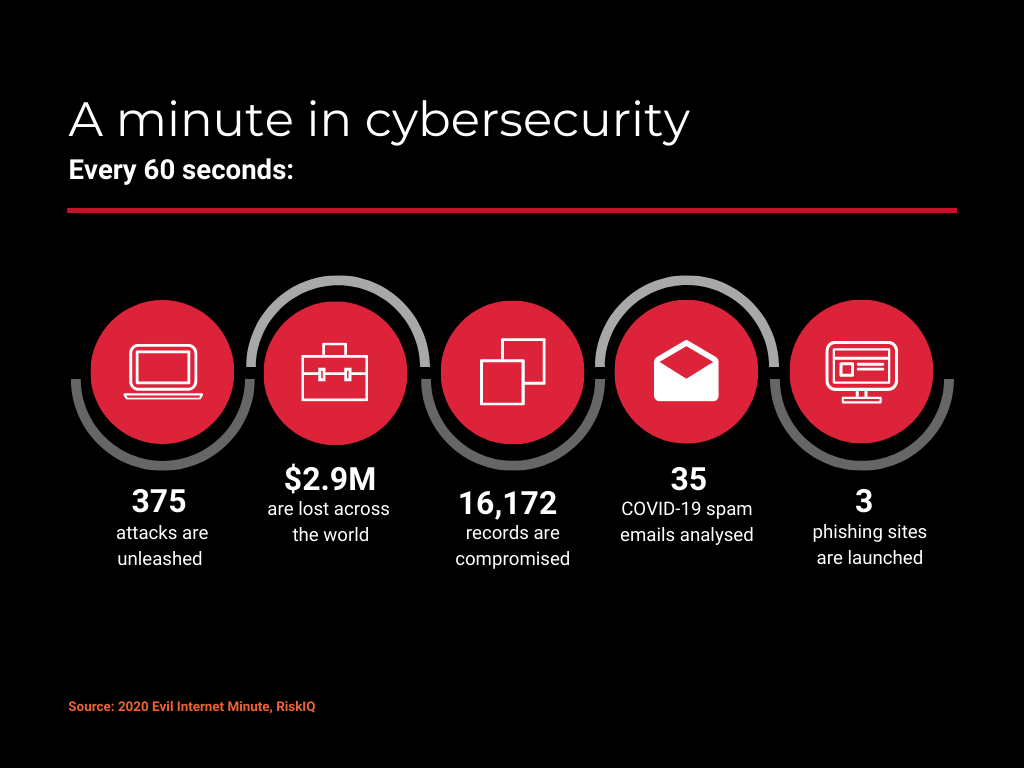
    Firstly, every 60 seconds, 375 attacks are unleashed upon the global community, costing the world economy $2.9 million. In other words, every single computer with an internet connection is targeted by malicious agents about 1.5 times per minute. A whooping 16,172 records are compromised.[1] Certainly not a promising picture if you are a business leader or oversee a company’s cybersecurity for a living.

    As we celebrate cybersecurity awareness month to promote greater security and cyber hygiene, we would do well to keep in mind that every day should be cybersecurity awareness month. Therefore, we can all benefit from a deeper understanding of today’s most common threats and what we can do to protect our business systems from them.

    Cybersecurity in 2020: the impact of the pandemic

    The already complex world of enterprise security got further intricate with the advent of COVID-19. Also, the sudden shift to remote work has pushed company networks to the limit, opening a myriad of new potential points of entry for attackers to exploit. Additionally, the ensuing fear and confusion have given more leverage to attackers looking to deceive individual employees as a means to gain company-wide access. As they say: you are as strong as your weakest link. And hackers love that.

    Cybsersecurity in 2020: the impact of the pandemic

    Social engineering, the act of tricking someone by using their natural tendencies and emotional reactions, has acquired a whole new dimension of sophistication and finesse. Phishing emails disguised as governmental safety announcements, fake HR memos encouraging you to get acquainted with the office’s new cafeteria policy. And that is just the start two per cent of all COVID-related websites created in recent months contain malicious code. A seemingly small number until you realise there are billions of COVID-19 pages out there.[2]

    Remote work is here to stay, and so are the advanced techniques that cybercriminals use. In fact, they will only get more refined in the months to come.    

    A growing variety of cyber threats – Cybersecurity in 2020

    In addition to the rising complexity of attacks, the sheer variety of techniques hackers use is a top concern for companies and cybersec professionals who are struggling to catch up with an ever-growing catalogue of threats. New forms of mobile malware alone, for instance, have grown 12% compared to last year. PowerShell-based malware, which leverages the Microsoft task automation and configuration management framework to carry out attacks without leaving any traces, grew by 1,902% over the same time period.[3]  

    Also discover our article & interview: Leadership Failure: The Real Human Element Behind Cyber Attacks

    Targeting the cloud

    Cloud has become the backbone of the modern enterprise, and hackers are targeting it accordingly. The rise in attacks is being particularly felt in those industries which depend the most on the cloud for productivity. For example, threats aimed at the transportation and logistics sector increased by 1,350% in the first quarter of the year. Education experienced a 1,114% rise in attacks, with governmental organisations, manufacturing and financial services following behind.[4]    

    The Top 10 Belgian Cloud Pros to Follow on Twitter

    Most attacks are opportunistic in nature and involve the “spraying” of cloud accounts with stolen access credentials. The majority of access attempts came from either China, Iran or Russia. [5] 

    Ransomware-as-a-service

    While phishing and trojans are still behind most cyber attacks, ransomware continues to surge and is perhaps the most feared malware of them all. Its capacity to cripple an entire company’s operations in a matter of minutes, together with how difficult it can be to prevent these attacks in the first place, surely keeps many security specialists and IT managers awake at night. Also, threat actors are becoming increasingly sophisticated.

    What started as attacks
    by individual hackers or small rogue groups has now evolved into full-fledged
    criminal organisations that operate under a ransomware-as-a-service approach.
    Some even have “customer service” helplines to guide victims through the
    process of paying the ransom.

    These hacker groups have greatly benefited from COVID-19, taking advantage of the increase in cloud usage and telework. Half of the world’s organisations were hit by ransomware last year, with most successful ransomware attacks involving public cloud data. Data was successfully encrypted in 73% of attacks.[6]

    Additionally, attackers
    are finding more and more weaknesses to exploit as remote workers and IT
    engineers increasingly use Remote Desktop Protocol (RDP) to access internal
    resources. The higher use of personal devices has also complicated the problem
    of shadow IT, multiplying the potential points of access and making it more
    challenging for security professionals to safeguard company networks.

    ? Subscribe to our podcast

    Join our community and find your next job or expert in IT

    [1] The 2020 Evil Internet Minute, RiskIQ, Inc. (2020)
    [2] 2020 Threat Report, Webroot (2020)
    [3] The McAfee Labs COVID-19 Threats Report, McAfee (2020)
    [4] McAfee Labs COVID-19 Threats Report, McAfee (2020)
    [5] McAfee Labs COVID-19 Threats Report, McAfee (2020)
    [6] The State of Ransomware 2020, Sophos (2020)
  • Weekly News: Windows Made With Linux

    Weekly News: Windows Made With Linux

    Is Linux the new Windows?

    The renowned
    open-source champion Eric Raymond has always been a huge Linux believer. 

    Raymond has long argued that the OS is destined to rule the
    desktop market. Now he’s gone a step further by saying that it won’t be long
    before Windows 10 becomes a simple emulation layer on top the Linux
    kernel. 

    According to Raymond, Microsoft’s latest investments in the Windows Subsystem for Linux (WSL) reveal that the Redmond, Virginia company might be quite aware of this impending shift. The company also has recently unveiled a Linux version of Edge for IT pros to test websites. 

    But there’s more: the Windows emulation might ultimately disappear altogether, leaving us with a Microsoft shell that is basically all built on Linux.

    ZDNet

    AI: behind the screens

    Despite the media buzz around AI, it can be
    difficult for someone who is not immersed in the technology to precisely tell
    you how and where it is being applied. 

    Well, this
    week we got a behind-the-screens look at what developers are doing in both the
    public and the private sector.

    The city of Amsterdam debuted the Algorithm Register, a portal where everyone can learn more about the various AI initiatives being implemented across the city. 

    Also, Alexa developers unveiled how they get Amazon’s smart home assistant to interpret what users mean rather than what they say. Here’s more

    The pandemic and S/4HANA implementation

    S4HANA implementation was ramping up before COVID-19 hit the global business community. Now, as uncertainty piles up, some organisations might consider postponing their migration to SAP’s next-gen ERP until things settle down a bit. 

    But should
    they? 

    In an interview with TechTarget, S/4 experts recommend taking advantage of the current disruption. The slowdown in activity offers a great opportunity for IT departments to undergo a more thorough examination of their legacy ERP and come up with a better ecosystem that delivers greater business value.

    The biggest challenge they face: convincing business leaders their S/4 project should move ahead.

    TechTarget

    ? Subscribe to our podcast

  • Nadia — Chapter IV

    Nadia — Chapter IV

    Follow the story of Nadia, a quantum security expert in 2050 London

    Nadia, a story by Miquel Morales.

    Jumping in now? Catch up with previous chapters.

    Chapter IV

    “You know, it’s not the
    first time I deal with the likes of you. Nor it will be the last, for that
    matter.”

    The woman had a
    distinctive voice. Coarse, yet sharp as a whistle. A slight lisp and the way she
    pronounced the ‘r’ betrayed her as a non-native English speaker. Eastern
    Europe, maybe? Hard to tell.   

    “Scoundrels. Corporate
    leeches who would rather put their energy to nefarious use than do their actual
    job. Tell me: what was it, how did they get to you? Money? It’s usually money. Perhaps
    the promise of a shiny new job?”

    Nadia tried to keep a steady
    face despite the woman’s determined scrutiny. A plain metallic table separated the
    two of them in the middle of an otherwise empty room. Exactly how one would
    imagine an interrogation room to look like.

    “Excuse me, where exactly are we?” It had been a relatively short ride to whatever that place was, but the back of the van they had put her in had no windows. In any case, they couldn’t have gotten further than a few blocks. Somehow, the secrecy of it all made Nadia think it had less to do with the actual police and more with someone else’s particular idea of justice. Ugh, so stupid. If only she had made it for the elevator a couple of seconds earlier, the policeman’s hand wouldn’t have been able to stop the doors from closing. Guess no one is naturally prepared to run from the police at a moment’s notice.  

    “Ah, she speaks!”

    “I do!” said Nadia with a
    mocking smile. “And I can tell you right away that I don’t have the foggiest
    idea of what you are talking about.”

    “Funny, because your
    friend said quite the opposite.”

    “My friend?”

    The woman pulled up some
    information on her bracelet’s screen.

    “Mr… Tom Schultz. Ah, chatty
    fella.” Wait, how was Tom involved in any of this? “We know you stole the
    RayStar duplos, so let’s go straight to the point, please.”

    “What?” It was impossible
    to hide her surprise this time around. “I did not do such… Wait. Are you even police?”
    Definitely not. This has RayStar written all over it.

    “Who is paying you?” The
    woman was clearly starting to lose her temper.

    The door opened and a man
    in a suit walked in. He leaned on to whisper something in the interrogator’s
    ear.

    “We’re not done here,”
    said the woman as she reluctantly stood up and followed the man out of the
    room. The door locked with a beep.

    Nadia finally let her guard
    down and allowed her body to show how nervous she really was, her right foot going
    up and down in an endless loop. She wished they hadn’t taken her earpiece. She
    could’ve used Ziza’s help with going through the events of these recent days. The
    duplos. But EVE had not gotten even remotely close to that data. She couldn’t
    have the way the system was designed. Especially not with that useless hidden attachment
    strategy. Plus, EVE’s target had always been the proprietary security
    algorithms of Nadia’s company. Or at least Nadia had assumed so, given her
    interest in getting close to the quantum encryption core systems. No, they must
    have made a mistake. Nadia hadn’t messed around with the duplo dataflows at
    all. Someone else had to be behind all this. Or had she missed something? She
    would just tell them about EVE, the attachments, the kidnapping of her sister…
    The door opened again. It was…

    “Tom?! What on Earth…”

    “Nadia, listen. There is
    no time.” He was all sweaty and dishevelled, his eyes full of fear behind the
    colourful glasses. “They know everything, they figured it all out. I’m so
    sorry. They had Hao’s file, and they said they would…”

    “Tom!” Nadia grabbed him by
    the shirt and tried to shake him into making some sense. “What is going on?
    What are you doing here, and what did you do?”    

     “I… There is no time! They will be back any
    second.” He took her by the arm and the two ushered into a dimly lit hallway
    with concrete walls. “You need to get out of the city. Didn’t you have a friend
    up in Coventry? “

    “I do. But my sister…”
    They were now running through a maze of corridors across what seemed like the
    basement of a large building.

    “Your sister is fine,
    don’t worry.”

    “Wait, how do you…”

    “She’s fine Nadia! You
    need to worry about yourself right now.” Voices and steps could be heard some
    distance behind them. The guards were in pursuit. And getting close.

    “Where is my sister?”
    They reached a fire escape door and Tom cracked it open, prompting the alarm to
    go off. The light of day filtered in, momentarily blinding Nadia.

    “Remember the party the
    other day? Wait until nightfall and head there. You will understand everything
    once I’ve also left you an untraceable paycard. You shouldn’t use any of your
    accounts until I contact you. Not until we clear our name.”

    “Tom – where is my
    sister!”

    “Where she has been all
    this time. At her place.”

    “What!”

    “Trust me Nadia, I’ve got a plan.” He reached inside his shirt’s chest pocket and took out Nadia’s earpiece. He handed it to her and pushed her towards the door. “Now go! I’ll keep them for as long as I can.”

    Flooded with questions, Nadia rushed out into a quiet back alley and started running without looking back. A shot could be heard in the distance.

    To be continued…

    Read the next chapter: Nadia — Chapter V
    Join our talent community

    Need tips on how to find a job in IT? Check out our IT job hunting guide.

  • A Microsoft Technologies Careers Guide

    A Microsoft Technologies Careers Guide

    Learn all about Microsoft careers and the various paths one can take within the Microsoft Technologies ecosystem with this guide.

    It was not that long ago that Microsoft seemed on track to take a more secondary role in the future of enterprise technology.

    Software sales had been sluggish for some time, and the company seemed unable to keep up with the pace of innovation of its competitors. Well, things change quickly, especially in IT.

    To the surprise of some, Microsoft has managed to bounce back in just a few years. It has indeed delivered its finest OS to date, Windows 10, created a new line of successful hardware products like the Surface. Thus it become a top contender in the cloud wars. Moreover, Microsoft is one of the biggest beneficiaries of the current situation. Being incredibly fortunate with cloud-based collaboration tools ranging from Azure and Office 365 to Microsoft Teams.

    Hence, investing time and resources in pursuing one of the many Microsoft careers is a solid career bet. Here is a little roadmap that we hope helps guide you on your journey to personal and IT professional success.

    Microsoft careers: a solid IT career investment

    Microsoft careers: a solid career investment

    The surge in remote work caused by COVID-19 has greatly helped the cloud industry. Microsoft’s Azure business keeps on growing, consolidating the company’s position as the world’s second-largest cloud provider with only Amazon ahead. In turn, the increased demand for cloud know-how has led to a severe drought of talent, especially in areas like cybersecurity. Both cloud and security are highly coveted these days.

    Additionally, in a world dominated by data, business intelligence is key. Here, Microsoft also reigns supreme with tools like Microsoft Power BI — a business intelligence platform that caters to business users. As an IT professional, knowing your way around MS Power BI will make you a great asset in today’s enterprise. There will always be someone in need of an expert to set up the environment, train end-users and troubleshoot.

    Finally, Microsoft’s sheer size and reach, as well as its tools and platforms focused on developers. This means that a vast amount of applications and solutions are developed using Microsoft’s technology.

    Ubiquity, scalability, flexibility and endless possibilities are the words that come to mind when trying to explain what Microsoft stands for in this day and age.

    In addition, the Redmond, Virginia company is almost everywhere and in everything, connecting the world economy across industries, practices and solutions.

    This Microsoft careers guide connects the dots and providing a holistic perspective on the Microsoft ecosystem and the various career paths one can take within.

    The Microsoft Technology Stack

    Microsoft careers: The Microsoft Technology Stack

    Ubiquity, productivity, scalability,
    flexibility. These are some of the words that come to mind when trying to
    explain what Microsoft stands for in this day and age. The Redmond, Virginia
    company is almost everywhere and in everything, connecting the world economy
    across industries, practices and solutions. Cloud, operating systems,
    repositories, collaboration tools…

    But, as an IT professional, you would encompass more than enough by focusing on the company’s core solutions. Here are the principal technologies in the Microsoft Technology Stack.

    The different IT career paths within Microsoft

    Microsoft careers: The different career paths within Microsoft

    Given the breadth and depth of Microsoft’s tech
    stack, the number of jobs and specialties that the environment comprises is
    practically impossible to capture completely and concisely at the same time.
    There are just too many.

    However, you can identify a series of recurrent role across the various technologies. The company itself highlights these common career paths in its training programs.

    Also explore our article on Microsoft career paths for an overview of the different career paths within the Microsoft ecosystem.

    Developing your Microsoft expertise

    Microsoft careers: Developing your Microsoft expertise

    As with other proprietary families of technologies, the best way to go about learning the basics and getting a foot in the door is through official Microsoft certifications. These provide you with a solid technical foundation while validating your expertise in front of recruiters and the overall industry.

    In conclusion, there is a myriad of certifications one can obtain, based on desired role or IT career path, or depending on the specific skills you would like to acquire.

    Here’s a quick guide to the world of Microsoft certifications.  

    Connect by Mindquest Newsletter

  • Weekly News: Artificial Intelligence, Minecrafting the Real World

    Weekly News: Artificial Intelligence, Minecrafting the Real World

    Since 2018, the Generative Design in Minecraft (GDMC) competition challenges participants to push the limits of artificial intelligence and come up with realistic cities from scratch.

    If you are unfamiliar with Minecraft (I doubt it), the cube-based video game lets players build all sorts of structures with almost absolute freedom. In other words, cubic freedom.

    Participants must leverage a combination of various Artificial Intelligence techniques in Minecraft to level terrain, build roads and bridges and erect buildings. It is a very complex task involving everything from path-finding algorithms to machine learning, but it’s starting to come together. 

    Surely the technology is still years away, but it looks like city planners and designers will soon have a new digital partner for their construction projects.

    Your future apartment
    building might well be designed by an AI architect. At least parts of it.

    Racist Artificial Intelligence strikes again

    And speaking of artificial intelligence I, yet another poorly trained algorithm has put yet another Internet giant in serious trouble. This time it was Twitter’s turn. 

    Have you ever wondered how the platform decides what parts of a
    picture to crop in preview mode? It is, of course, an image-cropping algorithm.
    Using a combination of tools, Twitter tries to prioritise faces and text,
    unless your face is black. 

    Ironically, the issue was discovered when a PhD student was
    trying to tweet about another racially-biased algorithm he had encountered on
    Zoom. The videoconferencing service had erased the image of his black colleague
    after failing to recognise his face. Twitter decided that wasn’t enough and
    erased his colleague from the screen capture too. 

    Although the company was quick to apologise for not testing the algorithm thoroughly enough, Twitter feeds quickly filled up with people doing experiments to test the flaw. Some even tried posting images of differently coloured dogs. 

    Time for lessons to be learnt.

    Announcements from Microsoft Ignite

    Microsoft has
    kickstarted its annual Ignite user-focused conference by announcing a series of
    additions to its cloud and productivity portfolios. 

    Teams is getting new security and compliance-related features,
    as well as a suite of new tools to help companies better support remote
    workers. The latter are mainly data insights to assess the overall wellbeing of
    employees, made available to users and managers to help them improve
    productivity and reduce burnout.

    The company has also teased Virtual Commute, an upcoming Teams functionality aimed at helping workers unwind after a long day of work. Hmm, how about not being on Teams after working hours to start with?

    Plans to expand Azure Stack’s hybrid cloud capabilities have also been announced. The platform lets businesses run public cloud-like workloads within on-premise data centres. Users will be now able to run and deploy containerized applications on the setup, while the Azure Stack Hub will incorporate GPU support for broader machine learning capabilities. 

  • IT Contractors: How to Ensure a Constant Stream of Work

    IT Contractors: How to Ensure a Constant Stream of Work

    Starting out as a freelancer is for many the realization of a life-long project. While the contractor status means there is no guarantee of job security, there are nonetheless several methods to perpetuate your collaborations and ensure a constant stream of work from loyal and happy customers. How to ensure a constant stream of work?

    Here is a quick overview of best practices for maintaining a robust client portfolio that provides you with a steady stream of work.

    Become
    indispensable

    To become irreplaceable, you have to develop a unique value proposition and, of course, get your work done on time. First of all, it is important to honour your commitments as agreed upon at the signature of your contract. But then you must go beyond and work to bring added value to the project. Inject a bit of your personal touch to make yourself stand out.

    Becoming indispensable means that from the very first interview, you must make sure to stand out, without going overboard. Your interview should not be a simple question/answer exchange, but a real discussion between professionals. Keep in mind that the person you will be working with is not your employer. You collaborate together, for a common goal. Anything that can bring a real, personalised touch to the project and that is not offered by all the other freelancers is to be highlighted. This will encourage your customers to seek to collaborate with you over the long term.

    Finally, remember that skills alone are not enough. It is essential that you find the right positioning between professionalism, rigour and proximity. You will thus assert your personality and demonstrate charisma while projecting confidence.

    Establish a healthy line of communication

    Healthy communication between a freelancer and their clients is essential to ensure long, win-win collaborations. So how do you do it?

    • Check in regularly, but without being pushy or appearing overly eager
    • Show your interest in the company and its projects. Typically, contractors who show an interest in the client’s broader work are more likely to snatch long-term collaboration contracts
    • Do not hesitate to ask for feedback on your work and to be proactive in proposing ideas This is greatly appreciated
    • Do not be afraid to clarify any unspoken or perceived misunderstandings. If you do not dare to discuss a potential issue for fear of string up the waters, the problem could end up weighing heavily both on your morale and your client’s satisfaction with your work
    • Anticipate your next mission. Ask questions about or propose future projects, as well as if you can help in any other areas. Besides giving you vital insight into your client’s operations, this attitude will help you become a long-term partner who goes beyond individual assignments and provides more strategic support

    Stay visible

    Once a mission is completed, and if you have received positive feedback, it is advisable that you connect with your points of contact over social media and professional networks like LinkedIn. This of course requires an active presence on the various platforms, as well as a solid online image.

    Keep your profiles updated and add new content on a regular basis. You can also publish promotional offers like discounts, or new services and skills you have developed. 

    If you are visible enough, your clients will remember you and your professional qualities. They will call on your services again, especially if you offer them loyal-customer discounts based on the volume of work requested.

    ? Subscribe to our podcast

    Join our community and find your next job or expert in IT

  • Site Reliability Engineer (SRE) : Job Description

    Site Reliability Engineer (SRE) : Job Description

    Use our template to create a compelling and comprehensive Site Reliability Engineer job description to attract top talent.

    The Site Reliability Engineer (SRE) is an increasingly coveted function within IT departments.

    The Site Reliability Engineer role stems from an approach to production systems management created within Google in 2003. As well as from the expansion of the DevOps mentality. The function is based on the implementation of synergies between development and operations to accelerate the creation and deployment of applications.

    Also discover our interview: How to Become an Azure MVP

    What is the role of the SRE?

    Analyze project specifications

    The first mission of an SRE is to analyze all security and operational problems of an application. Figuring then out what works and what doesn’t to optimize it.

    Work in collaboration with developers and salespeople

    The SRE regularly meets with developers and salespeople to benefit from their feedback and do a better job. The opinion of both sides is important to understand user experience and what the users criticize in terms of safety/reliability. They must understand what the developers have do at the technical level to assess problems more effectively.

    Deploy automation

    In order to save time and be more efficient, the site reliability engineer should be able to set up automated processes for recurring tasks.

    Also read the IT Infrastructure best practices

    Required skills of the SRE

    Be comfortable with programming languages

    The SRE should also be able to write and program all types of applications. And should also be comfortable with the most used coding languages including JavaScript, Java and .NET. More recent tools, ​​like Node.js or Golang, are also a plus.

    Translate business language into technical language

    In addition, when the SRE receives the specifications, they must be able to understand the app’s business goal and then put in place the technical means to resolve the problem.

    Understand all points of view

    The site reliability engineer will also have to put himself in the shoes of the developers. But also of the end users to understand what roadblocks may arise and how to overcome them.

    Within the industry

    In general, an SRE is first and foremost a developer, who, in addition, has knowledge of operational infrastructure and performance issues.

    Salary of the SRE

    The average daily rate of a Site Reliability Engineer fluctuates between €550 and €750.

    Training to become an SRE

    To become a Site Reliability Engineer, it is best to have a background in computer science and a focus in language and programming.

    ? Subscribe to the podcast

    Join our community and find your next job or expert in IT

    How To Code Well: Taking Breaks and Other Pieces of Timeless Career Advice

  • Weekly News: Fishing for Data & Data Storage

    Weekly News: Fishing for Data & Data Storage

    Fishing for Data, cloud storage, data center, AI, cloud gaming and DevOps, discover latest news with Mission Control Center by Mindquest.

    Data storage & Liquid cooling

    Some weeks ago we
    learnt how a future where cloud gaming was the norm could see emissions rise by
    30%. 

    Maintaining a data centre and a data storage is a costly endeavour. Especially because of how much power is devoted to cooling the hardware. But Microsoft has a solution. 

    Earlier this week, the company retrieved a cylinder-shaped data centre it had sunk off the Scotland coast two years ago. Albeit covered by algae and barnacles,; the data centre is in perfect working order and has in fact proven to be more reliable and efficient than traditional server rack environments. 

    Researchers attribute the positive results to a combination of less human interaction and cooler temperatures; as well as to the nitrogen that was used for ventilation instead of the usual oxygen. Which reduces corrosion.

    Although one could wonder how an ocean floor full of servers would affect global water temperatures. 

    BBC

    Snakeoil sellers beware

    And speaking of AI…

    An international coalition of medical experts has introduced the
    world’s first standards for clinical trials involving artificial
    intelligence. 

    The standards, which were published on Nature Medicine and The
    Lancet, are aimed at tackling the current hype around AI and preventing
    interested parties from leveraging the media attention to sell dubious
    research.

    The move comes at a time when the entire world is laser-focused on Covid vaccine clinical trials. An area in which AI can help speed up things immensely. Applied wrongly, however, the technology could endanger millions of people.  

    MIT Technology Review

    DevOps: the future of the enterprise

    In an interview with
    SiliconANGLE, Gene Kim, the DevOps guru behind books like “The Phoenix
    Project” stressed how vital DevOps is to the future of the
    enterprise. 

    At a time when ensuring effective data storage, management and
    analytics is so pressing, businesses are prioritising developer operations to
    make informed business decisions.

    Kim argues that DevOps not only helps organisations’ bottom
    line; it is the new bottom line.

    A focus on empowering developers, Kim says, will undoubtedly reward companies with unprecedented freedom and agility.

    SiliconANGLE

    Discover our article: The IT Jobs Market of Today

  • The Mindquest Manifesto

    The Mindquest Manifesto

    Technology is reshaping not only the ways in which we live and communicate but also how we work. Discover the Mindquest Manifesto.

    The skills we need to be successful in our careers and business projects—that means both hard and soft skills—are constantly evolving. The ways in which companies and teams operate are changing dramatically, even more so since the start of the pandemic. But that is just the beginning. The classical employee-employer relationship is being fundamentally redesigned.

    These sudden and
    profound changes can be confusing for both companies and employees, creating a
    great deal of uncertainty and posing a new set of challenges.  

    Today’s IT
    professionals are concerned about how to best manage and build a successful
    career of their choosing in an ever-changing environment where skills must be
    constantly updated to stay relevant. On top of that, tech workers, like any
    other professional collective, have personal lives to attend to and want to
    figure out a way to achieve career success while ensuring that all their needs
    are covered at each stage of their life cycle. Should they work as a permanent
    employee, or as a freelance contractor? The answer might change depending on
    which point of their lives they are in.  

    For companies and IT
    managers, it is all about how to adapt to and stay ahead of this changing
    landscape while retaining agility, competitiveness and a cohesive approach to
    talent and operations. New ways of working require shifts in company structure,
    as well as new ways of managing teams that are increasingly composed of both
    permanent employees and external contractors. Aspects like maintaining a
    unified company culture, securing the best talent before the competition does,
    and preparing for upcoming regulations are of major importance to today’s
    business leaders.     

    At Mindquest we like
    to think of these changes as a journey, for professionals as well as for
    businesses. 

    The journey requires
    all parties to be in constant motion, to step out of one’s comfort zone, to
    make a few mistakes and learn a lot to keep on advancing.

    Some people can get
    lost along the way and make the wrong decisions, resulting in greater concerns,
    anxiety, and a waste of talent and energy.

    Mindquest – This is where we come in.

    Our mission is to
    provide people and businesses with the best possible guidance and support
    throughout their entire professional journey. For us, it’s all about people,
    and it’s all about growth — personal and business growth.

    We are here to uncover
    the true potential of brilliant and unique minds and help them build their
    desired career paths, working with companies and projects where they will be
    able to excel and achieve their professional goals.

    We are here to help
    business leaders find the best IT talent and develop comprehensive talent
    strategies that generate as much value as possible.

    We are here to create
    a new kind of community within the tech sector, to create long-lasting
    professional relationships and partnerships from a win-win perspective.

    We are here to help
    our partners live up to their full potential in this new technology-driven
    world of work.

    We are here for you.

    Join our talent community - Mindquest

    Join our community and find your next job in IT

    Also discover our special guide: IT Job Hunting Done Well: A Step-by-Step Guide